# Choosing the Right Pallet Rack: When to Use Drive-In vs. Drive-Thru Systems
Efficient warehouse storage is a cornerstone of effective supply chain management. As businesses seek to maximize their storage space while maintaining accessibility and product integrity, selecting the right pallet racking system becomes paramount. Among various options available, **drive-in** and **drive-thru pallet rack systems** are two popular solutions designed to optimize high-density storage. However, despite their similarities, each system serves different operational needs and warehouse layouts.
This comprehensive article delves into the critical considerations for choosing between drive-in and drive-thru pallet racking systems. By understanding their design differences, advantages, limitations, and ideal use cases, warehouse managers can make informed decisions that enhance storage efficiency, safety, and throughput.
---
## Understanding Pallet Rack Systems: The Basics
Before diving into the specifics of drive-in and drive-thru racks, it’s essential to understand what pallet racks are. Pallet racks are structural frameworks that store palletized goods in horizontal rows with multiple levels. They allow forklifts to place and retrieve pallets safely and efficiently, maximizing vertical and horizontal space utilization.
Among the many types of pallet racks — such as selective, push-back, and cantilever racks — drive-in and drive-thru systems are categorized as **high-density storage solutions**. They are designed primarily to increase storage volume by reducing the number of aisles required, which is ideal for warehouses with limited floor space or large volumes of homogeneous products.
---
## What is a Drive-In Pallet Rack?
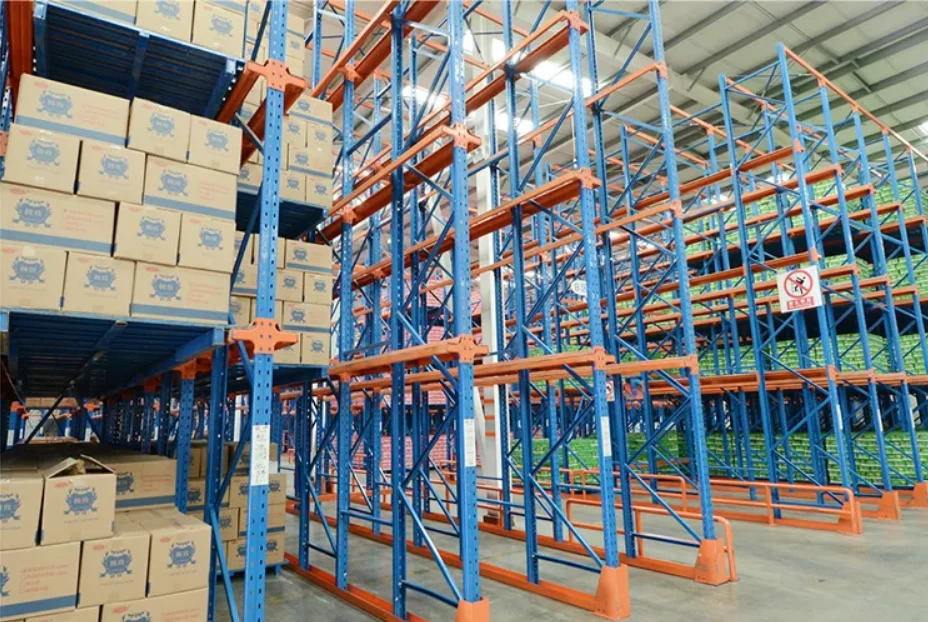
A **drive-in pallet rack system** allows forklifts to enter the rack structure from one side only to load and unload pallets. This system is characterized by a series of deep lanes where pallets are stored several positions deep on rails or supports, accessed by driving the forklift directly into the rack.
### Features:
- **Single entry/exit point:** Forklifts can only enter from one side.
- **Last In, First Out (LIFO) inventory flow:** Pallets loaded last are retrieved first.
- **High-density storage:** Maximizes the use of vertical and horizontal space.
- **Pallets stored on rails or beams:** Supports run longitudinally inside the rack.
### Advantages:
- **Space efficiency:** Reduces aisle space, increasing overall storage capacity.
- **Cost-effective:** Generally lower cost than more complex automated systems.
- **Suitable for large quantities:** Ideal for storing many pallets of the same SKU.
### Limitations:
- **Inventory control challenges:** LIFO nature can complicate stock rotation.
- **Limited accessibility:** Only one entry point can slow retrieval times.
- **Requires skilled operators:** Forklift drivers must maneuver safely within tight confines.
---
## What is a Drive-Thru Pallet Rack?
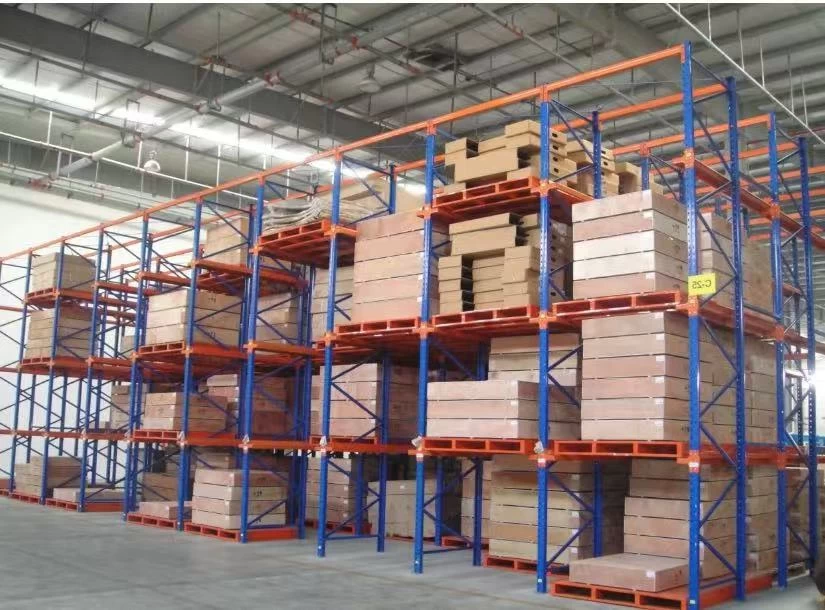
A **drive-thru pallet rack system**, on the other hand, has entry and exit points on both sides of the rack structure. This means forklifts can drive through the rack from either side, allowing for more flexible loading and unloading.
### Features:
- **Dual entry/exit points:** Forklifts access racks from both front and back.
- **First In, First Out (FIFO) inventory flow:** Pallets loaded first are retrieved first.
- **Deep lane storage:** Similar to drive-in, pallets are stored multiple positions deep.
- **Rails or beams support pallets within the rack.**
### Advantages:
- **Improved inventory rotation:** FIFO operation is ideal for perishable or time-sensitive goods.
- **Better accessibility:** Access from both sides reduces handling time.
- **Maintains high-density storage:** Similar space savings as drive-in racks.
- **Flexible workflow:** Can integrate with cross-docking and distribution operations.
### Limitations:
- **More aisle space required:** Requires two aisles at both ends of the rack.
- **Higher initial investment:** Larger footprint and more complex installation.
- **Potential traffic management issues:** Requires coordination of forklift traffic from both sides.
---
## Key Considerations When Choosing Between Drive-In and Drive-Thru Racks
To determine whether a drive-in or drive-thru pallet rack system is best suited for your warehouse, consider these critical factors:
### 1. **Inventory Type and Turnover**
- **Drive-In:** Best for homogeneous products with low turnover and less stringent stock rotation requirements. Examples include durable goods, bulk storage, or items with long shelf life.
- **Drive-Thru:** Ideal for perishable goods, food items, pharmaceuticals, or any inventory requiring strict FIFO rotation to prevent spoilage or obsolescence.
### 2. **Warehouse Layout and Space Constraints**
- **Drive-In:** Requires only one aisle per storage bay, maximizing space utilization in warehouses with limited floor area.
- **Drive-Thru:** Needs aisles on both ends, which increases aisle space but provides better flow and flexibility.
### 3. **Inventory Management Strategy**
- Evaluate whether your business prioritizes **LIFO** or **FIFO** inventory flow. Drive-in racks inherently operate on a LIFO basis, whereas drive-thru racks facilitate FIFO.
### 4. **Throughput Requirements**
- For warehouses with high throughput demands and frequent pallet movement, drive-thru racks offer better operational efficiency due to dual access.
- Lower throughput environments might benefit from the compactness of drive-in systems.
### 5. **Safety and Operator Skill Level**
- Both systems require trained forklift operators, but drive-in racks pose more risks due to tight maneuvering spaces.
- Drive-thru racks, with dual access points, may reduce some operational hazards but require careful traffic management.
### 6. **Cost Implications**
- Drive-in racks typically have lower upfront costs due to simpler design and fewer aisles.
- Drive-thru racks involve higher installation and maintenance expenses but may yield greater long-term operational benefits.
---
## Practical Applications and Industry Examples
### Drive-In Pallet Racks: Use Cases
- **Cold Storage Warehouses:** Maximize storage density where temperature-controlled environments restrict expansion.
- **Manufacturing Plants:** Store bulk raw materials or finished goods with minimal SKU variety.
- **Automotive Parts Depots:** Handle large volumes of identical parts efficiently.
### Drive-Thru Pallet Racks: Use Cases
- **Food and Beverage Distribution:** Ensure FIFO to maintain product freshness.
- **Pharmaceutical Warehouses:** Manage expiration-sensitive medications with strict rotation.
- **Retail Distribution Centers:** Facilitate rapid replenishment and order fulfillment.
---
## Integrating Technology and Design Enhancements
Modern pallet rack systems increasingly incorporate technology to optimize performance and safety:
- **Warehouse Management Systems (WMS):** Track inventory positions and manage stock rotation seamlessly in both drive-in and drive-thru setups.
- **Safety Sensors and Cameras:** Enhance operator visibility and reduce collision risks in narrow aisles.
- **Automated Guided Vehicles (AGVs):** Can be adapted to work with high-density racks, particularly drive-thru configurations for streamlined flow.
---
## Conclusion: Making the Optimal Choice
Choosing between a **drive-in** and **drive-thru pallet rack system** hinges on balancing storage density, inventory characteristics, warehouse layout, and operational priorities. While both systems excel in maximizing space, the decision largely depends on your company’s inventory flow model (LIFO vs. FIFO), product type, and throughput requirements.
- Opt for **drive-in racks** if space is at a premium, inventory is homogenous, and LIFO inventory management is acceptable.
- Choose **drive-thru racks** when FIFO inventory flow is crucial, product variety exists, and operational efficiency in loading/unloading is a priority.
By carefully evaluating these factors, warehouse managers can implement a pallet rack system that not only maximizes storage capacity but also aligns with safety standards, operational workflows, and long-term business goals.
---
## Additional Resources
For further reading and technical guidance on pallet rack design and warehouse optimization, consider the following:
- **Material Handling Industry Standards**
- **Warehouse Safety Guidelines by OSHA**
- **Warehouse Management System Integration Whitepapers**
---
*Note: While this article discusses the functional and operational aspects of pallet rack systems, it’s important to engage with qualified engineering professionals and suppliers to tailor designs specific to your warehouse environment.*
---
By making an informed choice between drive-in and drive-thru pallet racks, businesses can unlock significant efficiencies and create safer, more productive warehouse operations.